On Nov 11 2026, I documented finding an interesting book-keeping issue between the vote tally numbers and the turnout numbers as reported by the Virginia Department of Elections (“ELECT”) (previous write-up is here). By subtracting off the reported turnout numbers from reported per-precinct, per-race vote totals I computed the number of “excess” votes.
At the time I wrote the piece, while nearly completed, the vote tallies and data from ELECT was still being finalized. I noted as such in my write-up, and my main point was that we should expect the data released by ELECT as they were finishing the processing to be at least self-consistent, even if the data is still “unofficial”.
It is now Sat 11/14/2026, and all the vote numbers should be complete and recorded. So I went back to the data to see how things have changed.
There are a few things I’d like to examine here:
- Have the precinct and locality data streams in the ENR json file converged?
- Are there still excess votes and self-consistency problems with the data?
- How do the excess vote numbers computed from the ENR json dataset compare to numbers computed from the “Election Results” csv file?
- Does the data match the ELECT website?
- What significant changes occurred in the data from the time of my previous examination to now?
Have the precinct and locality data streams in the ENR json file converged yet?
Yes. The 3 different data streams in the json file look to have converged, so at that file is now internally self consistent. I pulled the files multiple times throughout the last few days and waited until it looked like the files had converged to run the final results and check for excess votes.
In my previous post I discussed the fact that the ENR json file has 3 different data streams in it, one dataset for each race, one dataset for each race + locality, and one dataset for each race + locality + precinct. As election officials are counting and updating information there are significant discrepancies between these 3 streams at any given moment in time, with the precinct information usually significantly lagging the other data streams.
It was not until ~6pm (Sat Nov 14th) that the json file data streams finally converged to consistent values.
Are there still excess votes and self-consistency problems with the ELECT data?
Yes, but only by a very small amount.
As a recap, I used the Election Night Reporting (“ENR”) json file downloadable from the ELECT website and build a table of the amount of votes cast in each race in each precinct. I then used the Turnout report csv file, also available from the ELECT website, to subtract off the total number of ballots cast at each precinct from these totals. It should be logically impossible for one to get more votes than ballots cast on any single choice race, so any result of this subtraction with a positive remainder is by definition in “excess”.
This is the exact same method as before, just with new data files all downloaded at approximately 11/14/2026 23:36:37. The metadata from the ELECT website shows that their data files were last updated at 17:53:39.
The new computed amount of excess votes is only 10. The previous total was 163,399. So that’s a drastic improvement in data consistency, but it’s notably still not quite 0, as we would want it to be.
| Race | Excess Votes | Affected Precinct(s) |
| Member, House of Representatives (4th District) Member | 3 | PRINCE GEORGE COUNTY 105 – HARRISON |
| United States Senate | 4 | PRINCE GEORGE COUNTY 105 – HARRISON |
| House of Representatives (5th District) | 1 | MECKLENBURG COUNTY 102 – ANTIOCH CHURCH |
| Member, Proposed Constitutional Amendment Question 1 | 1 | MECKLENBURG COUNTY 102 – ANTIOCH CHURCH |
| Proposed Constitutional Amendment Question 2 | 1 | PRINCE GEORGE COUNTY 105 – HARRISON |
How does using the ENR json data compare to the “Election Results” csv file for computing excess votes?
Instead of using the json ENR data file, there is another csv data file made available by the VA dept of elections that can be used to compute the excess votes. It is available at the same location as the turnout report.
The Election Results.csv data file should provide the same set of data as the ENR json and gives an alternate method for building the results table used for this computation.
I had apparently decided to do things the hard way earlier by parsing the JSON results! The json does seem to be made available earlier than the election results.csv file with regard to when the links on the website go active.
There does seem to be a difference in the way the csv file handles Write-In candidates and totals, which is something to be aware of for anyone trying to look into this data for themselves. The csv has a separate “WRITE-IN-VOTE” column and does not include those tallies in the “TOTAL_VOTE” column. In order to compare the two datasets, one needs to account for this.
Also, up until the ~6pm update on the ELECT website, the csv and json files, even when downloaded simultaneously showed different results.
After the 6pm update, the two datasets finally gave consistent answers.
Do the vote totals in the data match what is showing on the elect website?
Yes.
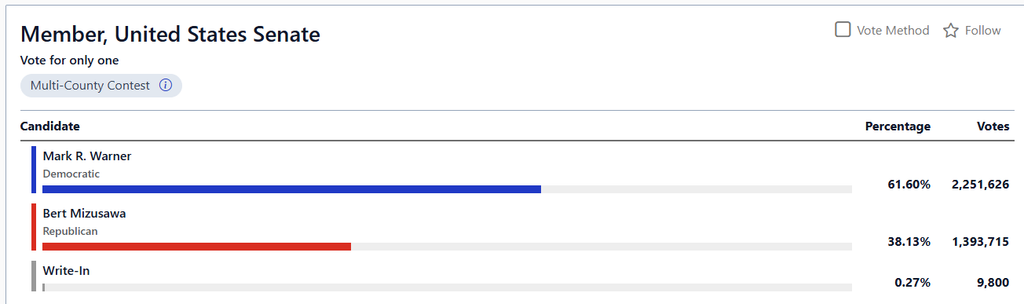
For example the race for US Senate is displayed on the website as having Warner = 2,251,626, Mizusawa = 1,393,715 and Write-In = 9,800. The post ~6pm csv and json data files both agree with these numbers. However, just like as described above, up until the final update neither the json or csv were in agreement with what was being displayed in the browser, even though the data was collected simultaneously.
What significant changes occurred in the data files from the time of previous examination to now?
A significant amount of changes were made pertaining to the distribution of turnout categories associated with processing the final mail-in and provisional ballots. Ballots that were previously being tracked as Provisional, or Post-Election got moved and reassigned into other categories, etc.
The attached excel spreadsheet shows the changes between the 11/14 datasets and 11/11.